
C7.Q1 Conduct and report on an analysis of the overall shape of the relationship between birth mass and maternal dominance status. Your answer should reflect different elements of (i) fitting a model using R, (ii) properly describing your model, and (iii) making a clear and complete biological statement of your findings.
I investigated potential non-linearities in the regression of offspring birth mass (


where 


The polynomial regressions were implemented with the following code:
m1<-lm(BirthWt~dominance, data=unicorns)
m2<-lm(BirthWt~poly(dominance,order=2,raw=TRUE),
     data=unicorns)
m3<-lm(BirthWt~poly(dominance,order=3,raw=TRUE),
     data=unicorns)
I evaluated the models visually by plotting
domRange<-seq(min(unicorns$dominance),
max(unicorns$dominance),length.out=30)
par(mfrow=c(1,3))
plot(unicorns$dominance,unicorns$BirthWt,col="gray")
predInterval(m1,data.frame(dominance=domRange))
mtext(side=3,outer=FALSE,"first order")
plot(unicorns$dominance,unicorns$BirthWt,col="gray")
predInterval(m2,data.frame(dominance=domRange))
mtext(side=3,outer=FALSE,"second order")
plot(unicorns$dominance,unicorns$BirthWt,col="gray")
predInterval(m3,data.frame(dominance=domRange))
mtext(side=3,outer=FALSE,"third order")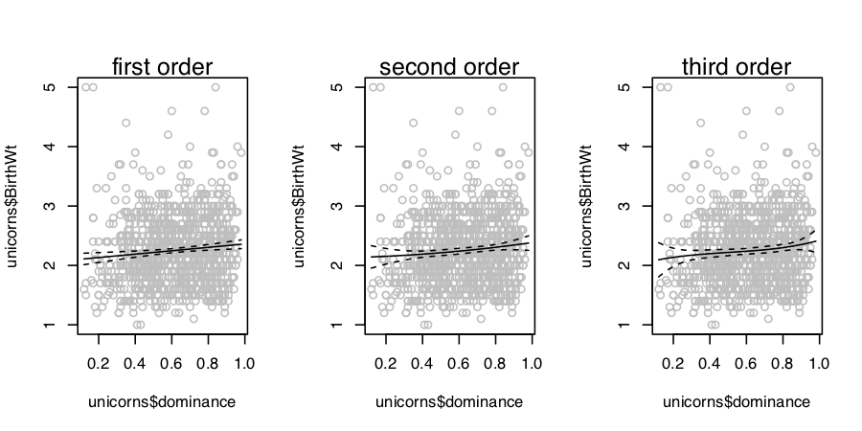 Figure 1. Depictions of first- through third-order polynomial regressions of birth mass (kg) on maternal dominance status (proportion of extant individuals to which a focal individual’s mother is dominant) in unicorns.
There appears to be very little evidence for non-linear components of the regression of offspring birth mass on maternal dominance status (figure 1).
Note that this answer could be further elaborated. Did your answer include a higher quality figure? If so, how was it better? Mine could use sub-plot labels, nicer axis labels giving units, and its caption could more completely describe what the solid and dashed lines are. My description could benefit from some quantitative description of the estimated coefficients of the polynomial regression models. Unless I had a very specific reason to be interested in curvature (rather than the perfectly reasonable motivation of simply checking whether there is any major curvature that I might want to be aware of), I would be inclined to focus any quantitative reporting on the linear regression model.
You may have noticed a change in my model description strategy. I changed from my standard use of 


C7.Q2 Make up a bit of code that can plot the function relating to an arbitrary polynomial over some range of values.
Here is my function. The key argument is terms, which is assumed to be the terms of the model, starting with the intercept, then the linear term, then a quadratic term, going on up to however high of a polynomial order is desired. The other argument, xvals, has a default, so if we don’t specify values of 
myPoly<-function(terms,xvals=seq(0,10,length.out=30)){
k<-length(terms)-1
n<-length(xvals)
yvals<-array(dim=n)
for(i in 1:n){
yvals[i]<-sum(terms*xvals[i]^(0:k))
}
plot(xvals,yvals,type="l")
}
# test the function
par(mfrow=c(1,2))
myPoly(c(0,1))
myPoly(c(0,5,-1))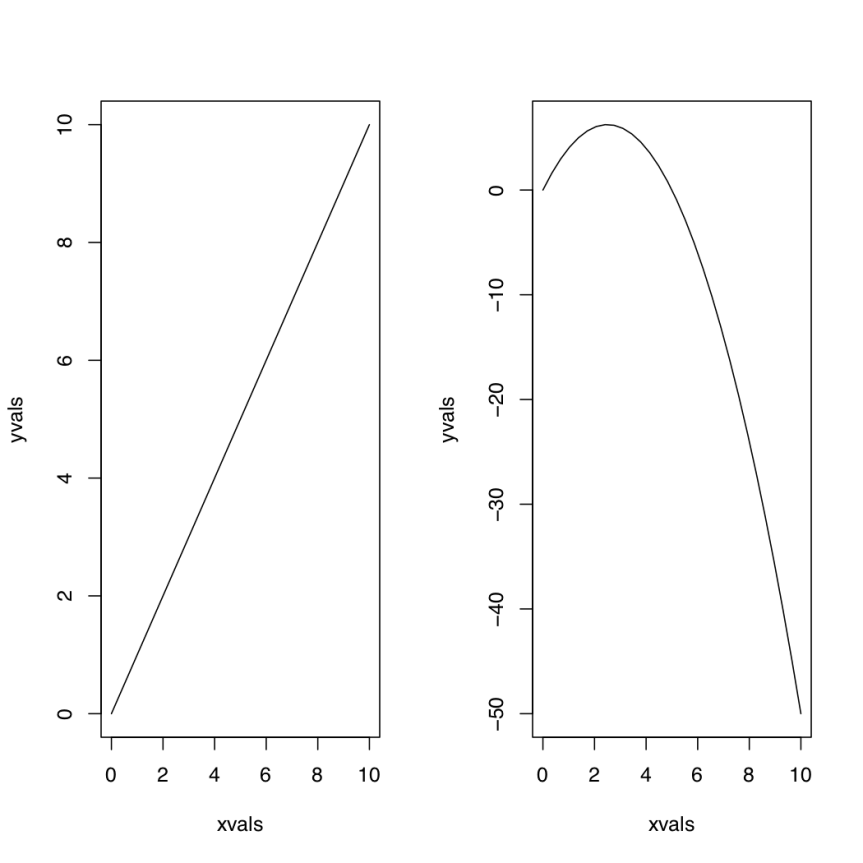 You should be able to follow how my function worked, by taking it one line at a time. It may help you if I break down one key part. In order to raise some number (say, 2), to the powers zero through 3, a compact trick is
2^(0:3)## [1] 1 2 4 8C7.Q3 Use your function to work out (probably by trial and error, but think it through first if you can!) how to make a function that initially increases quickly, then slows down (though perhaps still increases, just slowly), and then begins to increase quickly again.
The simplest function is a pure cubic function according to 
myPoly(c(0,0,0,1),xvals=seq(-3,3,length.out=30))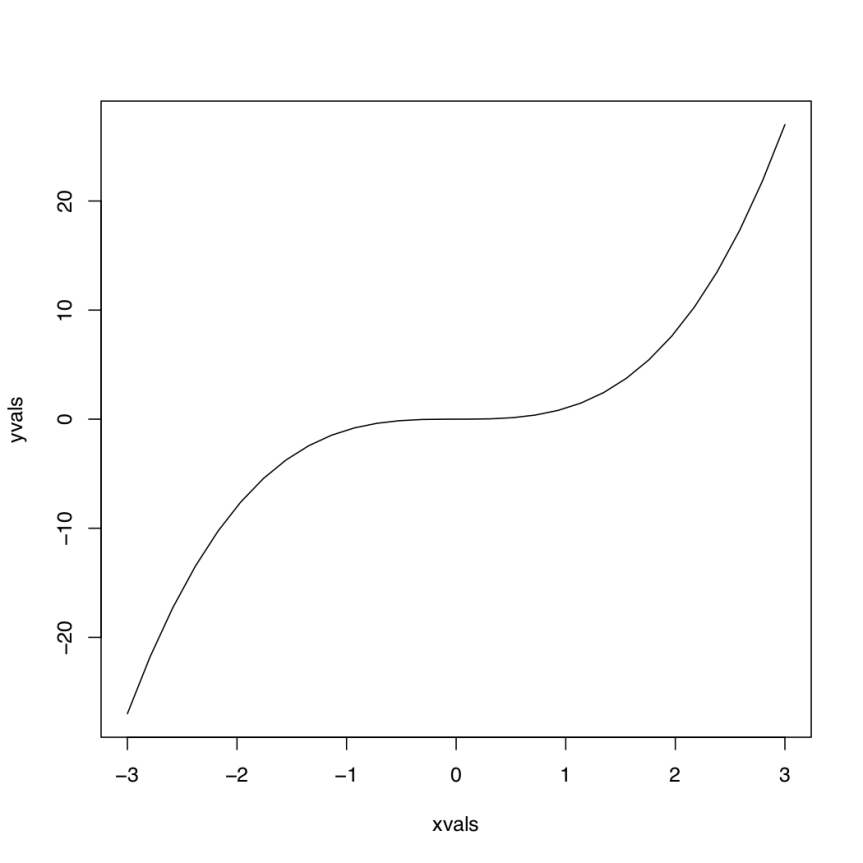
If we had wanted the function to work over the original range that was the default for the function we made in the last question, we would have to shift it to the right. This takes a bit of calculating to go from the same function as above, but centered on a value of 


You don’t necessarily have to do the calculations (as I said in the question, trial and error was OK, but possibly surprisingly hard). But either way you could come up with something like this:
myPoly(c(-125,75,-15,1))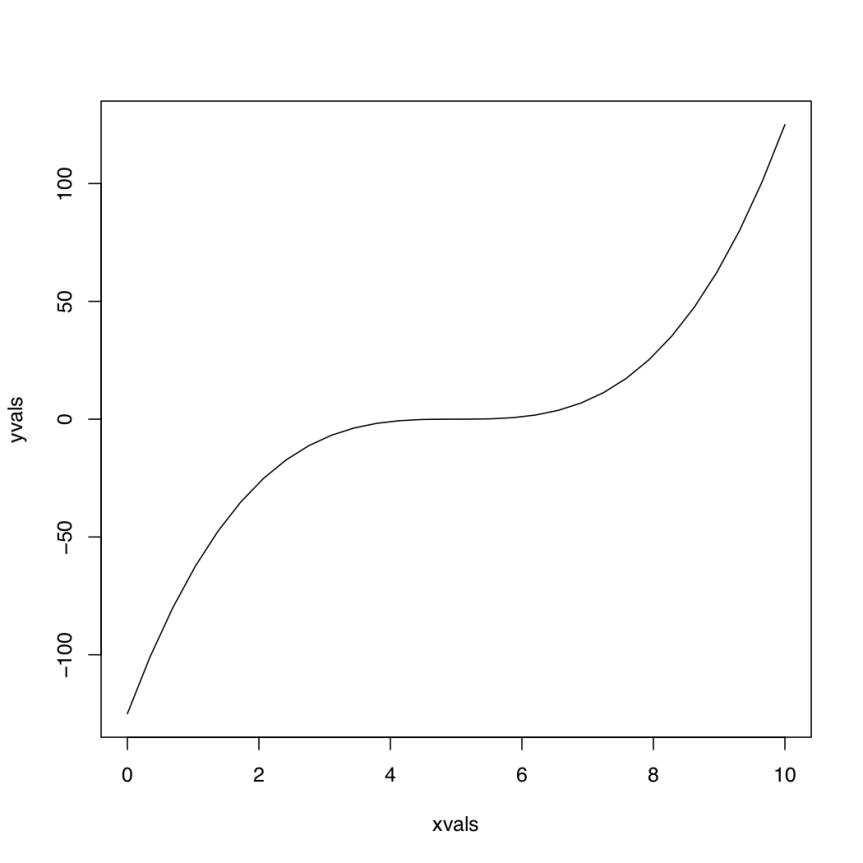
 Biology Statistics Textbooks